Zoom has fast become the world’s go to video conferencing app during the Coronavirus outbreak, and during March the app is said to have been downloaded 100 million times.
But as #Zoom has risen in popularity, security issues have come to light, with an increased amount of users reporting #zoombombing and data privacy concerns.
Many teachers are now using Zoom to support remote learning and some are using the app to teach live lessons, so what do you need to know about security on Zoom, and what can you do to maximise safety if you are using Zoom?
Check out our fast facts below:
What is Zoom?
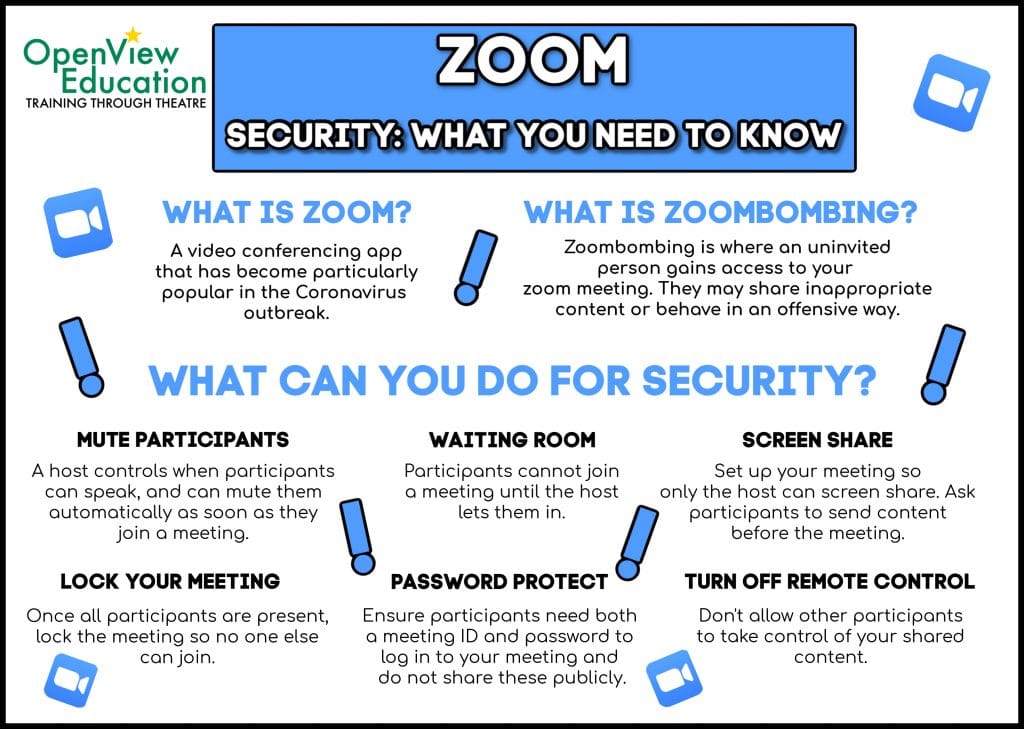
Zoom is a video conferencing tool that has fast become the favourite app for hosting virtual meetings during the coronavirus outbreak. Participants join a meeting using a Meeting or User ID, can change their meeting backgrounds, and screen share to show other participants what is on their screen.
What is Zoombombing?
Zoombombing is where an uninvited person gains access to another user’s zoom meeting. Zoombombers may share inappropriate content or use offensive language towards other participants.
Are there security features available?
Yes, whilst not fool proof the features that Zoom have introduced do go some way to protecting your meetings.
Hosts should apply the below security measures as good practice for every meeting they host. These features are accessible easily in the settings section on Zoom.
Waiting Room:
If participants arrive early to a meeting, ensure they can’t enter until the host is there. Enable the waiting room feature so that the host needs to let them in.
Mute Participants on arrival:
Enable the ‘mute participants on arrival’ feature on zoom so that if your meeting is zoombombed, the person entering it will be silent and other participants won’t be able to hear what they’re saying.
This feature also allows the host to control when participants can be unmuted, so a host controls who speaks during the meeting.
Turn off screen share:
Ensure that only the host can screen share content during the meeting, and that this feature is not available to other participants. If other participants have content to share, ask them to securely send this to you before the meeting begins and then share it on behalf of them.
Turn off remote control:
Zoom has a feature which enables participants to take control of another user’s screen whilst they are screen sharing, make sure this feature is turned off.
Password Protect your Meeting:
Don’t make it easy for uninvited people to gain access to your meeting. Create a new meeting ID and password for each meeting that you host, and do not share this publicly.
In our Internet Safety Training and Workshops, we talk with young people and children about keeping personal information safe online and using the internet safely. One of the most common ways a Zoombomber can gain access to your meeting is via accessing your meeting link and/or password in a public space online. Make sure you are sharing these privately and safely.
Turn off the File Transfer Function:
Disable the ‘file transfer’ function so that participants can’t share files in the meeting, ask them to securely send you the files before the meeting.
Lock the Meeting:
Once all participants are present, lock the meeting. This means other users can’t join your meeting.
Turn off ‘Allow Removed Participants to rejoin’
Turn this feature off so that if you do need to remove someone from your meeting for any reason, they cannot rejoin afterwards.
If you are going to be teaching lessons on Zoom, or hosting zoom meetings, ensure that the safety measures are put into place. Zoom is just like any other app, look into the privacy features and maximise these before you begin using it.
OpenView Education is a training and education company, providing innovative Anti-Bullying, Internet Safety Training and Mental Health Workshops for schools. Are you looking for more advice on different social media apps? Check out our free internet safety guides here or contact us.